
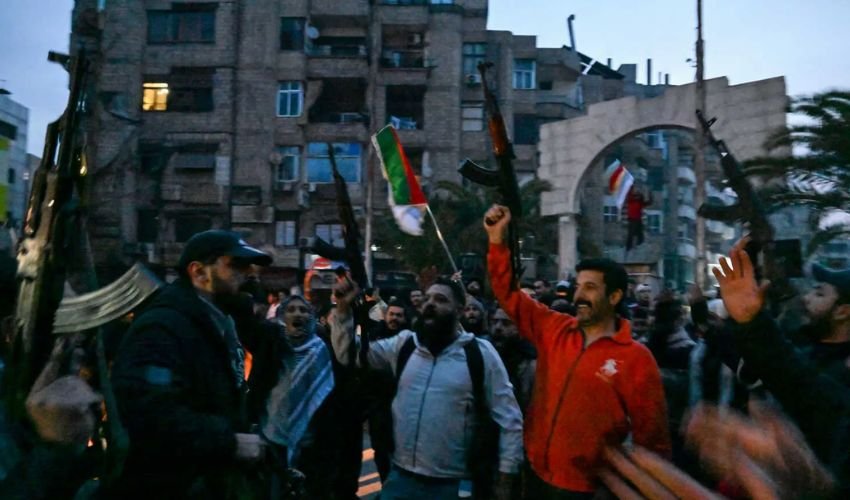
Syrian rebels declared Damascus “liberated from Assad’s rule.”
Earlier on Sunday, Bashar al-Assad, known for suppressing dissent during his tenure, reportedly left Damascus for an undisclosed location, according to two senior army officers. Rebels announced they had entered the capital without encountering significant army resistance.
Crowds of thousands gathered in Damascus’s central square, both on foot and in vehicles, waving flags and chanting “Freedom” to celebrate the end of decades of Assad family rule, eyewitnesses reported.
“We join the Syrian people in celebrating the release of prisoners and the end of the era of oppression associated with Sednaya prison,” said rebel leaders.
Sednaya, a notorious military prison on the outskirts of Damascus, has long been used by the government to detain thousands of individuals.
Flight tracking data from Flightradar showed a Syrian Air flight departing Damascus airport around the same time rebels claimed control of the capital.
The aircraft initially headed toward Syria’s coastal region, a stronghold of Assad’s Alawite sect, but then abruptly changed direction and vanished from radar. The identities of those on board have not been verified.
On Sunday, Hadi al-Bahra, leader of Syria’s primary opposition group based abroad, announced that Damascus was “free from Bashar al-Assad.”
Celebrations erupted as Prime Minister Mohammad Ghazi al-Jalali expressed his readiness to support the continuation of governance and collaborate with any leadership chosen by the Syrian people.
Frontlines in Syria, which had been largely inactive for years, suddenly became active as rebel forces gained ground. Former Al Qaeda-linked Islamist factions reemerged, posing the most significant threat to Assad’s power since the conflict began. The regime’s long period of survival, aided by allies like Russia, Iran, and Hezbollah, appeared to be in jeopardy as these allies faced other priorities, leaving Assad vulnerable.
In a rapid shift, rebels took control of Homs, a strategic city, within a day of fighting. This victory disrupted a key highway linking Damascus with the Alawite coastal strongholds, cutting off Assad’s supply routes and access to Russian military facilities.
In Homs, crowds celebrated the army’s withdrawal with chants of “Homs is free” and “Down with Bashar al-Assad.” Rebels fired celebratory shots into the air, and locals removed symbols of Assad’s rule, including tearing down statues of his late father, Hafez al-Assad.
The capture of Homs marked a powerful resurgence for the rebel movement. The city had been ravaged by years of siege warfare, pushing the rebels out and leaving significant damage. The victory also enabled rebels to release thousands of detainees from prisons as security forces fled and burned documents.
Abu Mohammed al-Golani, leader of Hayat Tahrir al-Sham (HTS), called the capture of Homs a historic moment. He urged fighters to spare those who surrender and reassured minority communities about their safety, seeking to present a more moderate face for the leadership.
Rebel commander Hassan Abdul Ghani revealed plans to extend control to the countryside around Damascus, with forces pushing toward the capital. Within 24 hours, rebels also took control of Syria’s southwest.
These swift developments surprised regional powers, prompting neighboring countries like Saudi Arabia, Turkey, and Jordan, as well as Russia and Iran, to issue a joint call for a political resolution, highlighting concerns over potential regional instability.
The Syrian civil war, which began in 2011 as a rebellion against Assad’s government, has drawn in international forces, enabled jihadist activity, and led to mass displacement. While the resurgence of HTS has reinvigorated the opposition, many Syrians remain concerned about its extremist past.
Golani has tried to reassure both the international community and minority groups, stressing his opposition to foreign Islamist violence. In areas such as Aleppo, recently captured by rebels, there have been no significant reports of retaliatory acts, though doubts persist.
Assad’s dependence on allies like Russia, Iran, and Hezbollah has weakened due to their involvement in other conflicts. Russia’s focus on the Ukraine war and Hezbollah’s losses in its conflict with Israel have hindered their capacity to support Assad.
As events continue to unfold, the lack of a decisive international response remains a major factor in shaping Syria’s future. U.S. President-elect Donald Trump has previously suggested that the U.S. should not intervene and allow the situation to “play out.”