

As France faces renewed unrest, the damage inflicted on shops and ordinary citizens raises an uncomfortable question about the meaning of social justice and the legacy of past revolutions.
By the Editorial Team | 20 October 2026
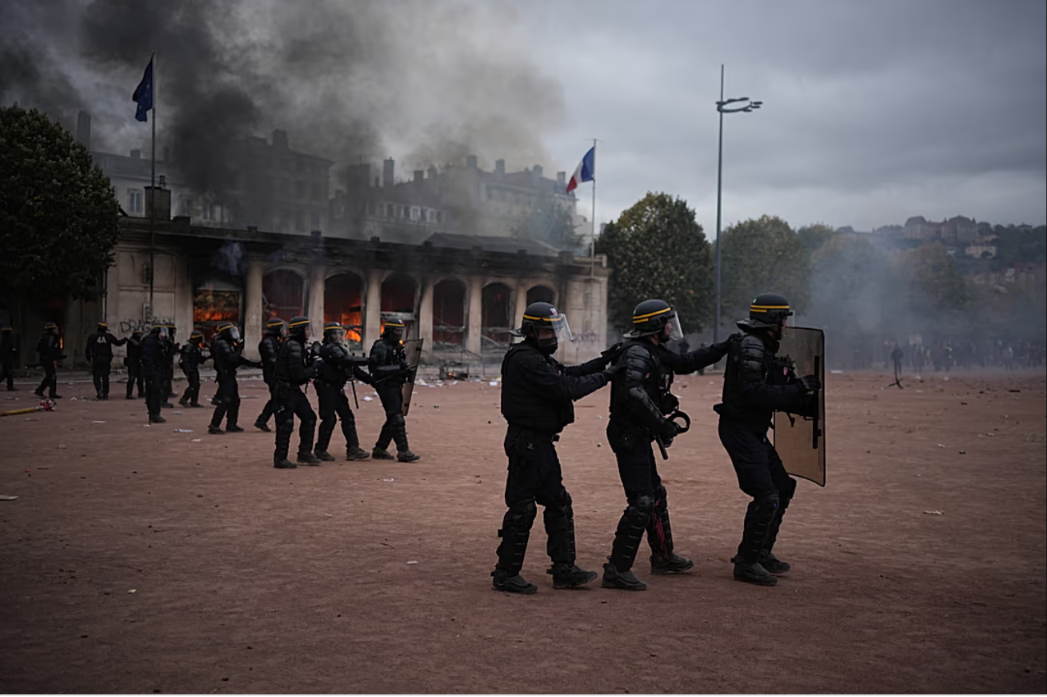
France has once again found itself at the centre of social unrest. On 17 October, demonstrations over the rising cost of living and deteriorating public services spread across the country. While hundreds of thousands of people reportedly took part in demonstrations, much of the attention has since shifted to the violence, looting and destruction that accompanied the protests in several cities. The French authorities have responded with local curfews and the first court convictions of individuals involved in the disturbances. According to Euronews, more than 3,000 businesses were vandalised. <Cite refs={[“turn369736search0″,”turn369736news11”]}/>
Beyond the immediate security crisis, these events raise a deeper historical question: what happens when a movement that claims to defend ordinary people ends up destroying the livelihoods of ordinary people?
France is a country whose identity has been profoundly shaped by revolution. From 1789 to the Paris Commune of 1871, its history contains struggles against privilege, demands for political representation and attempts to improve the conditions of working people. Yet the current unrest also highlights a contradiction between the pursuit of social justice and the destruction of the property on which many families depend.
The French Revolution and the promise of equality
The French Revolution of 1789 remains one of the most influential political events in modern history. It challenged absolute monarchy, inherited privilege and the inequalities of the ancien régime. Its ideals of liberty, equality and citizenship helped reshape political thought far beyond France.
However, the historical legacy of the Revolution is more complex than a simple story of the people rising against the powerful. The Declaration of the Rights of Man and of the Citizen also recognised property as a fundamental right. The Revolution therefore contained a commitment to individual rights alongside its challenge to the old social order. <Cite refs={[“turn369736search3”]}/>
This distinction matters when considering the destruction of shops, cafés, workshops and other commercial establishments today.
A small shop owned by an ordinary citizen is not necessarily a symbol of wealth or privilege. It may represent decades of work, family savings, loans and the hope of building a more secure future. For its owner, the shop is not an abstract symbol of the economic system; it is a livelihood.
When such a business is looted or set on fire, the consequences do not automatically fall on the wealthiest members of society. They can fall on independent traders, employees, suppliers and families who have little capacity to absorb the losses.
The central question is therefore not whether people have the right to protest against economic injustice. They do. It is whether the destruction of other people’s livelihoods can reasonably be presented as a means of achieving that justice.
The workers’ struggle was about more than destruction
France’s revolutionary history includes powerful movements that sought to transform the conditions of working people. The revolutions of 1848 brought demands for employment, political participation and social reform into the heart of national debate. Later, the Paris Commune of 1871 introduced measures addressing wages, working conditions and abandoned workshops.
Historical accounts of the Commune describe initiatives intended to protect workers and organise production in workshops whose owners had abandoned them. These measures reflected an attempt, however contested and short-lived, to address material insecurity through social and economic reform. <Cite refs={[“turn369736search8″,”turn369736search6”]}/>
It would be inaccurate to suggest that all earlier French revolutions protected property or avoided violence. The French Revolution involved confiscations, political repression and extensive bloodshed; the Commune itself emerged from armed conflict. Nor were the interests of workers, artisans, merchants and property owners always aligned.
Nevertheless, the social question was central to many of these historical struggles: how could people obtain work, fairer conditions, political rights and a greater degree of control over their lives?
That question is different from simply asking who can cause the most disruption.
A movement that seeks better wages, affordable living conditions and stronger public services has identifiable social objectives. Its credibility depends in part on whether its methods advance those objectives or impose additional burdens on the very people already struggling to make ends meet.
When the victims are ordinary citizens
The events of 17 October have brought this contradiction into sharp focus.
Reporting by Reuters described widespread looting, fires and damage to public buildings and commercial premises. Subsequent reporting also highlighted the difficulties faced by shopkeepers attempting to recover after the destruction. <Cite refs={[“turn369736news11″,”turn369736search2”]}/>
Consider a family that operates a small clothing shop. Rising rents, energy costs, taxes and declining consumer spending may already be placing its business under pressure. If the premises are then vandalised or looted, the family must confront repair bills, lost stock, interrupted income and uncertainty about reopening.
Employees may lose working hours. Suppliers may go unpaid. Customers may find fewer local services. Even when insurance covers part of the damage, compensation can take time and may not cover every loss.
These consequences are especially troubling when the wider protest movement claims to represent people facing economic hardship.
Small businesses are not all identical, and some commercial interests have considerable wealth and influence. But it is a mistake to treat every shopkeeper as an embodiment of the economic elite. Many independent traders work long hours, employ only a handful of people and have limited financial reserves.
Destroying their businesses does not, by itself, redistribute wealth, improve public education or reduce the cost of living. It can instead deepen economic insecurity in neighbourhoods that are already vulnerable.
The destruction of an ordinary person’s livelihood is not proof of social progress. It is a loss that requires its own justification—and one that slogans about revolution cannot supply.
Protest is a right; violence is not a substitute for reform
None of this means that the grievances behind the French demonstrations should be dismissed. The cost of living, the quality of public services, educational conditions and confidence in political institutions are legitimate subjects of public debate.
Nor should the conduct of violent participants be used to discredit everyone who took to the streets peacefully. Reporting on the October protests distinguished between the large number of demonstrators and the groups involved in looting, arson and confrontations. <Cite refs={[“turn369736news11″,”turn369736search1”]}/>
That distinction is essential in a democratic society.
Peaceful protest allows citizens to expose injustice, demand accountability and press governments to change their policies. Trade unions, civic organisations, public demonstrations, strikes and political participation can all provide ways of applying pressure without deliberately destroying the livelihoods of uninvolved people.
Violence, meanwhile, risks shifting public attention away from the original demands and towards questions of public order. It can also create divisions among citizens who might otherwise share concerns about wages, prices and public services.
There is a further danger: when violence becomes widespread, governments may respond with restrictive security measures that affect peaceful demonstrators as well. The challenge for the French authorities is therefore twofold—protect people and property while preserving the right to lawful dissent.
The first convictions and the imposition of local curfews demonstrate the seriousness with which the authorities are treating the unrest. Whether those measures will restore confidence or merely contain the immediate disorder remains to be seen. <Cite refs={[“turn369736search0″,”turn369736news10”]}/>
What does revolution mean in the twenty-first century?
The word revolution carries considerable moral and emotional weight in France. It evokes the overthrow of privilege, the struggle for rights and the possibility of building a different society. But historical memory can become misleading when it is used to justify every act committed in the name of popular anger.
Revolutions have never been uniform movements with a single purpose or a consistent record. They have produced reforms and new rights, but also repression, destruction and unintended consequences. Their legacy must be assessed through their objectives, their methods and the lives they changed—not merely through the dramatic nature of the events themselves.
The French experience offers an important lesson: social justice cannot be reduced to opposition to authority, wealth or the existing order. It also concerns the conditions under which ordinary people live, work, trade and support their families.
If a protest demands that workers be protected from economic insecurity, it should take seriously the economic insecurity created when small businesses are destroyed. If it demands dignity for ordinary citizens, it should recognise that shopkeepers and employees are ordinary citizens too.
This does not mean placing commercial property above human rights or treating every act of civil disobedience as equivalent to a riot. It means asking whether the means employed are consistent with the social objectives being proclaimed.
A society can debate taxes, wages, wealth distribution and the responsibilities of government without accepting that the destruction of a neighbour’s business is a legitimate expression of solidarity.
A revolution worthy of its social ideals
France’s present crisis is not simply a confrontation between protesters and the state. It is also a test of the relationship between anger, responsibility and the meaning of solidarity.
The grievances expressed in the demonstrations deserve serious examination. Economic hardship and declining confidence in public services cannot be resolved by dismissing citizens’ concerns. Governments must address legitimate demands, while the justice system must distinguish peaceful protest from acts of violence and deliberate destruction.
At the same time, those who invoke the language of revolution should be willing to confront the consequences of their actions. A movement cannot convincingly claim to defend ordinary people while disregarding the harm inflicted on ordinary families, workers and independent business owners.
The historical importance of France’s revolutions lies not only in the overthrow of old institutions, but also in the enduring debate about rights, equality and the organisation of society. That legacy should encourage a more demanding question than whether a protest appears radical or disruptive.
It should encourage us to ask what kind of society the protest is trying to build—and who is being asked to pay the price.
A movement that seeks justice for workers must also consider the workers who serve customers, the families who run local businesses and the employees whose jobs depend on those premises. Defending their livelihoods is not a betrayal of social justice. It is part of the challenge that social justice is meant to address.
France’s revolutionary heritage remains relevant precisely because these questions have not disappeared. The challenge today is to pursue meaningful change without turning the lives and livelihoods of ordinary citizens into collateral damage.